Wednesday, March 04, 2015
Ice Dive ~2015~
Sunday, March 30, 2014
Wednesday, January 29, 2014
Tempus Frigid
Sunday, January 23, 2011
Ice Training ~2011~

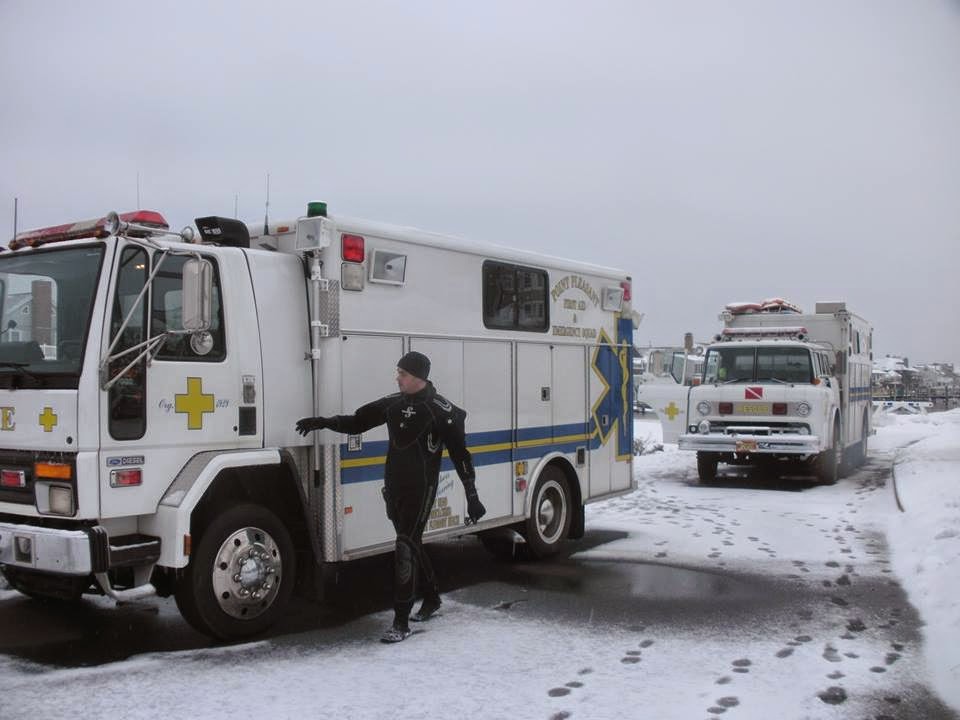
On Sunday, 1/16/11, the Point Pleasant Beach First Aid Squad - divers and EMTs - had a very productive Ice Rescue/Dive drill. For some long-time members, this was an annual refresher, but for several newer members this was a first-time exposure to these scenarios. We don't necessarily get ice thick enough to train on/under every winter, so the last few weeks of cold weather turned out to be a blessing.

We used a bayside cove off of Bergen Avenue in Mantoloking for the drill. Lt. Barcus, former diver and Liaison with Mantoloking PD, stopped by and made sure that the local authorities and residents were aware that this was a drill.

On arrival, Chief Nesley first reviewed how to evaluate ice conditions and getting on safely. Our drysuited divers then went to test the extent of walkable ice. (You could, of course, easily discover this by just walking until you break through; it was walkable two steps before that point.) Alternately, we practiced sensing the first flexing of the ice, and then got down on hands and knees, and then spread out flat to distribute weight and stay on top of things as long as possible.


Once in, everyone then practiced pulling him/herself and a victim out of the hole. This is not easy when the edge continues to break underneath the weight of two people. We then demonstrated that a human chain is an effective remedy for this, as is use of a tethered backboard. Asst. Chief Melo also presented patient care protocols once any victim is removed from the ice.

We then prepared for scuba dives under the ice. We started out with the standard triangular entry hole (which came out very neat this time). Seven divers then took turns being harnessed, tethered, and tendered under the ice. Our line pull system is a simple but effective means of communciation between diver and tender, so we practiced delivering instructions very deliberately.


Tom T was first in and experienced some navigation issues on his first ice foray since last year, but his second assigned course went much more smoothly. Getting comfortable under the ice takes time, as first timer Dave found out next. Doug and Tom C took their turns with smooth results, although the vis by the hole was getting murky.


On Sue's run, she'd been instructed to come up to the bottom of the ice in the middle of the cove so that Chief Nesley could show everyone topside what a diver's bubble trail looks like through the ice. However, the ice was too thick and frosty to much make out the diver, but they cut a fresh hole big enough to fit a head out. Sue once again proved that you shouldn't expect to be able to chisel your way out from down below with a knife (Newton was right - equal and opposite reactions). Finally, Eric and Chet took their turns, and we all wondered how they navigate so well under these conditions. All the while, Flo stayed topside with EMTs Jen, Max, Tom G, and Captain Meany, briefing them on what the divers were doing and the assistance they might need upon exit.

Having spent over 3 hours on and under the ice, most of us had cold hands, but everyone (wet and dry) felt that this was very productive. You never know what you'll get a real ice call, but we feel better prepared to respond.
.
Monday, January 18, 2010
Ice Rescue Training and another Seal save...

For the middle of winter, this was an interesting day. It started when Flo Melo, our Assistant Dive Chief, got a call from the Marine Mammal Stranding Center to investigate two more local seal sightings in Manasquan and Brielle, neighboring towns just to the north across the Manasquan River. Throughout our winter, it is very common for seals to come ashore to rest or nap, but this isn't common knowledge. When Flo and Tom went to evaluate the harbor seal on the beach, some bystanders weren't even aware that there were ANY seals in New Jersey. Consulting with the MMSC via cell phone, it was determined that this one was in no distress and required no human assistance other than to be left alone. When we returned later in the afternoon, all that was left was a set of flipper tracks back to the ocean. The second seal, laying on a dock in Brielle, was even a little feisty, vocally letting Flo and Tom know that he did indeed wish to be left alone. We are told that every holding tank in the Stranding Center's Brigantine facility is full right now, so this was good news for everyone!

The Dive Team then conducted an ice rescue drill with the Mantoloking Fire Department. Our Squad provides coverage for Point Pleasant Beach, BayHead, and Mantoloking, so this was a great opportunity to work with other emergency service volunteers who might one day provide us surface support. It was 40 degrees, windy, and rainy, but everyone was ready to drill. Chief Nesley first demonstrated to the firefighters to how to evaluate ice conditions, especially if properly suited divers are not yet available to assist with an ice rescue. The firefighters were then introduced to the drysuits that our divers are outfitted with, and they practiced helping a diver into the suit. We were
especially concerned with proper handling of the suit's zipper and ensuring proper neck seals.

We then went though various shore support and rescue options for the firefighters. Everyone took their turns with throw bags, the safest way to get a line out to someone in ice without risking someone else falling through. We then demonstrated backboard use to remove a victim from an ice hole, and the firefighters got the feel of hauling the board back to shore. We also might call upon the Fire Department to tend line for us. Just like last week's ice diving drill, we practiced tying appropriate knots for a diver's harness. Several of the firefighters also got a feel of our line pull system of communication.

We had a lot of line to clean, but the firefighters were introduced to the equipment we might use and now know what to expect during an ice rescue. We are thankful to know that one day they could have our backs.

.
Sunday, January 10, 2010
Ice Rescue Drill ~2010~

On January 10, 2010, the Point Pleasant Beach First Aid Dive Team got the year's serious training off to a good start with a very productive Ice Rescue drill. The weather has been below freezing for two weeks now, with the nights dipping into the teens, so several of the coves on the Barnegat Bay-side of our coverage area were iced over enough to re-drill on ice surface rescues and ice diving.
.
diver.
We practiced our line pull system of communication, which is simple but works well, especially with each diver focused strongly on navigation. Under the ice in these coves, many of our natural navigation cues (sun angle, sand ripples, channel contours, established currents) are unreliable. Surrounded by steel bulkheads, our underwater compasses worked in some places and not-so-well in others. Eric gets the award for Best, Long, Straight Line Swim. Tom Trafer, training for the first time with ice, found out quickly how easy it is to get disoriented, and the value of an attentive tender. Fortunately, visibility was 5-10 feet, so we all got a nice underwater tour. We didn't see too much in the way of active marine life, but Sue located numerous snails and worm mounds, and
Chet found a small eel, frozen right up under the ice.
We then drilled on Surface Ice Rescue. What do we do when someone falls through the ice? We practiced crossing the ice while distributing our weights, so that the rescuer does not fall though for as long as possible. We then practiced falling through to ensure that you yourself do not go under. The harder parts were getting yourself back out, and, most importantly, getting a victim back out of the ice. We all practiced using a backboard to remove an unresponsive victim out of the loose ice closer to the bay.
.
Thanks go to one of our Squad's EMTs for keeping an eye out for us, providing hot packs for our hands and chocolate chip cookies too! As much as most of are NOT fans of long cold spells, this provided us with a great opportunity to drill on handling a likely winter rescue scenario.
.
Monday, February 16, 2009
Wednesday, February 28, 2007
Monday, February 12, 2007
Cold water Rescue Dive Training...
Extreme cold water and ice conditions demand specialized training in the search, rescue, and recovery tactics used in this environment and continuing training is a must to maintain a ready status team.
The Point Pleasant Rescue Dive Team is made up of a strong team of dedicated Scuba divers who are all volunteers and spend a considerable amount of their free time training and increasing their skills. They also volunteer much of their time supporting the Point Pleasant First-Aid team which they are associated with.
I am fortunate to know many of these Rescue divers and have trained and certified with many of the team members. I am able to return to the Jersey Shore every month or so to dive and train with this team and I find their dedication to the team and the community refreshing and commendable. This team spends a considerable amount of time diving and are usually in the water 2 to 3 times a week as compared to many teams that only train once a month if that. Unfortunately many First-Aid\Rescue teams have a large percentage of members who are in it to “Wear the Jacket” and be seen as part of the unit. Both the Point Pleasant First-Aid and Rescue Dive Teams have very impressive staffs that are also very visible in the community.

Team Captain and PADI master Dive Instructor Chet Nesley has been instrumental in developing the team and has incorporated many of the Dive Masters that he has certified into the Rescue Dive Team. Following is a description of this weekends training session…
“Did ice diver training today. Did surface rescue and did ice dive training for the new members Dan sager, Eric Poplick, Mark Ostovish. We have a lot of pictures, I'm sending them to you as I get them!" Dive and weather information, air temp 30f, water temp 29f, Visibility under the ice 0-5 feet."
A newspaper reporter was there, If it makes the paper I'll let you know.
Chet
Cold water rescues are not common for the fact is many people do not go into the water during these frigid conditions except in the case of an accident. Yearly “Polar Bear Plunges” are an exception and this team covers that event also with equipped divers in the water to assist those who choose to run into a frigid ocean…
Most cold water rescue scenarios involve a motor vehicle accident that results in the vehicle entering the water and submerged, and boating incidents. A remarkable fact in cold water rescue scenarios is a condition where the body will shut down to protect the “Core” system for survival purposes. This will extend the “Survivability” of the person in the cold water a considerable amount. I dug out my old Dive Master training manual and found the following description in “The Encyclopedia of Recreational Diving” which has an incredible amount of information about diving Physics, Physiology, equipment, and training procedures. Something that Chief Diver Chet Nesley required me to learn, and maintain, to keep my certification current…
"The Bradycardia response to apnea has sometimes been called tha mammalian diving reflex because it is found in diving mammals such as whales, seals and porpoises. The diving reflex in man is believed to have helped prevent deaths in near drowning accidents in youths in water below 50 degrees. Un these incidents, the near drowning victims have recovered with resuscitation, even after periods of 20 minutes or more without breathing. There are no apparent aftereffects."
"Physiologists believe the diving reflex concentrates the blood in the brain and heart, distributing the limited oxygen supply only to critical areas. That cold water on the faces seems to trigger the response explains why the diving reflex has been noted less in warm-water near drowning accidents…"
.jpg)



.jpg)


